Peak is here, is your operation ready?
Published 24/9/2026
Can your warehouse keep the promises your checkout makes during peak?

Subscribe to Delivered.
Black Friday officially begins nine weeks tomorrow.
Peak inventory is arriving, temp staff are starting, ‘SALE’ window decals are at the printers. But we’re not nine weeks away from peak season 2026, we’re 12 weeks into it.
In this week’s Delivered, we spoke to Jackson Martin, an Enterprise Customer Success Manager at Shippit.
Heading into his fifth peak season working alongside 30 of Australia’s biggest brands, Jackson explains how the strongest retailers plan before peak and adjust during it, and why the promise at your checkout matters as much as the discount beside it.
TL;DR
- Peak starts with the financial year, not the ‘SALE’ decals - the retailers who planned from July are better placed to capitalise in November
- Delivery optionality is as important as discounting, providing your warehouse can keep the promises you made at checkout
- An extended peak means retailers can adapt and adjust mid-course, so long as they have the data to tell them how
Peak started in July
Peak is synonymous with heavy discounts. Eager to capitalise on pent up demand, the industry has launched them earlier and earlier in recent years.
In 2025, Amazon launched its Prime Big Deal Days in early October. Myer quickly followed suit announcing its Super Weekend, while David Jones and Target ran their respective toy sale campaigns. Industry-wide, retailers kicked off their sales activity 13 days before Black Friday.
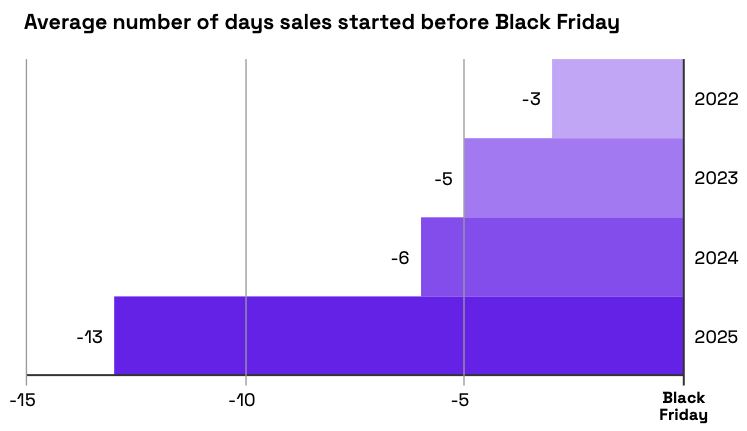
Ask Jackson when peak will start in 2026 and the answer is: months ago.
“Most of our biggest retailers come to us in July,” he says. “As soon as the new financial year begins, a lot of our top customers start their peak planning.”
“Customers might start a sale date early and that will trigger a number of other retailers to do the same. There’s big FOMO within the e-commerce industry.”
What are your customers actually looking for?
Peak is a sales period. Shoppers turn up expecting bargains - and there will be plenty to be had in the months ahead. In fact, promotions were the second biggest investment area for 2026 (behind only, you guessed it, AI) according to the State of Shipping Report.
But sales compress margins, and if you're relying on discounts alone, your customers’ loyalty lasts only as long as you’re the cheapest option.
“You need to have different service levels at checkout to differentiate yourself. It's not enough just to have a race to the bottom in terms of your cost of goods. There needs to be other drivers to encourage your recipients to shop with you.”
During peak 2025, retailers that offered same- and next-day delivery generated 4% more sales than the brands that didn’t. Almost half (45%) of retailers say same-day delivery is a top driver of retention and acquisition, yet only 13% provide it.
So why doesn’t everyone offer it? The answer, Jackson says, is hiding in your warehouse.
“Where a lot of these same-day and express offerings can fall over is if your warehouse teams, and your operations or your store teams can't pick and pack and essentially get those orders out within the stricter SLAs,” he says.
“So making sure your operations are capable of moving orders faster is probably the biggest factor for a lot of retailers that blocks them from rolling out faster options.”
If your operation can already pick and pack to a tighter SLA, adding the carrier is the easy part. If your operation can’t, it’s a conversation for next year. Either way, only promise what you can deliver.
One iconic British retailer learned the hard way.
Learning the hard way
On Black Friday 2015, Argos enjoyed its then-biggest day ever for digital orders: 12 million web visits, peaking at 18 transactions per second. It had launched a new same-day fast track service, and put 800 vans on the road to handle the surge.
Then came the complaints. Customers who had paid for next-day delivery posted that their orders still hadn’t arrived two days later, while others couldn’t get through to customer service at all. Argos was forced to issue an apology.
Stuart Higgins, a retail partner at LCP Consulting, said at the time: “Retailers continue to pursue a faster and freer agenda which is simply placing too much pressure on their back end infrastructure and carrier partners to deliver.
“With 1 in 10 deliveries risking failure this Christmas, retailers need to ensure they don’t promise what they can’t deliver or the customers will simply find a competitor who can.”
Eleven years later, most Australian brands have the same problem in reverse.
In 2026, retailers advertise an average delivery time of 5.2 days at checkout. Actual delivery takes just 2.2 days; a three day gap between what shoppers are told and what they get.
The buffer is born out of caution, but costs them in conversion. Only 7.2% of retailers currently show an accurate delivery estimate at checkout, despite 68% of consumers saying an accurate date before purchase is essential to them.
The Argos tale and the delivery ‘promise gap’ have common ground: a checkout promise that is disconnected from what the operation can actually do. And it’s not just a lost sale, it’s potentially a customer lost for good.
Amazon, Temu, and Shein are forecast to control 36% of the Australian market in 2026; winning wallets as high unemployment, interest rates, inflation, fuel costs and utilities curb consumer spending.
According to Roy Morgan CEO, Michele Levine, millions of Australians are turning to the affordability or convenience of the global giants: “Our data suggests that they’re taking $14 billion or so out of that market each year. This is not a pretty picture.”
With Amazon Prime Day starting even earlier again, running from 29 September to 5 October, the gauntlet has been laid down.
“You need to focus on those businesses, because they're picking up huge market share within the Australian e-commerce landscape. Amazon obviously has a brilliant same-day or next-day service for most of their items. It's not essentially copying them directly, but providing something that means consumers will stay on your site rather than moving to those competitors.”
“Shippit can support it all the way up until peak. We have the capability of rolling these carriers out right up until those traditional sale periods. And our estimated delivery dates enable retailers to provide the delivery certainty that many shoppers need.”
Use the window ahead to check that what you’re promising and offering at checkout is something your operation can actually deliver - and to find out while you can still do something about it.
A longer peak rewards the retailers that act during it
While planning in advance is a hallmark of leading retailers, so too is adjusting during it.
When peak was a four-day weekend in November and a pre-Christmas sprint, retailers were reliant on a very saturated, competitive window. By the time a trend showed up or an issue was identified, it was too late to do anything meaningful about it.
An event that now lasts for months works differently. A lane failing in week one can be fixed before the heaviest volume lands. An on-demand service level outperforming its forecast can take more of the mix. Weak cart conversion can be addressed before your CFO notices.
“The really strong retailers - those that planned months ago - don't just set and forget,” Jackson continues. “They optimise their allocation and different parts of their logistics process during peak.
“It's not enough just to leave things running and then retro after peak. You need to adjust on the fly to make sure your shipping processes don't fall over.
“The really strong retailers have real-time data in front of them. A lot of our customers use our analytics often, making booking and allocation decisions based on that data in real time.”
The problem for many retailers isn’t data shortage - it's fragmentation and descriptive (what happened) rather than diagnostic and predictive intelligence (why did it happen, and what's about to). So before November, ask yourself:
- Can we see how our operation is performing without juggling multiple log-ins, channels, and platforms?
- Can we see carrier performance, transit times, and zone-based results as peak unfolds, rather than in a retro?
- When a lane underperforms, can you move volume the same day or does it take a support ticket and a long wait?
- After you move volume, can you tell within a day whether it worked, or do you find out at Christmas?
“It's all well and good to review data and think ‘that's not good enough’,” Jackson continues.
“Shippit actually allows you to make changes: If you have a carrier or something that's not performing to your expectations, you can adjust on the fly and force allocation elsewhere to improve the overall experience for your customers.”
The retailers that win this peak won’t be those with the heaviest discounts. They’ll be the brands whose delivery promise converts shoppers without eroding margin, who spot a lane slipping on day three rather before it becomes too expensive, and who can move that volume because of the planning they did back in July.
If this edition of Delivered has made you re-think your peak planning, carrier mix or delivery promise, share it with the logistics and ecommerce leaders in your network.