3 ideas to steal for your next shipping meeting
Published 24/7/2025
This is what the smartest retailers are doing with fulfilment and delivery in 2025

Subscribe to Delivered.
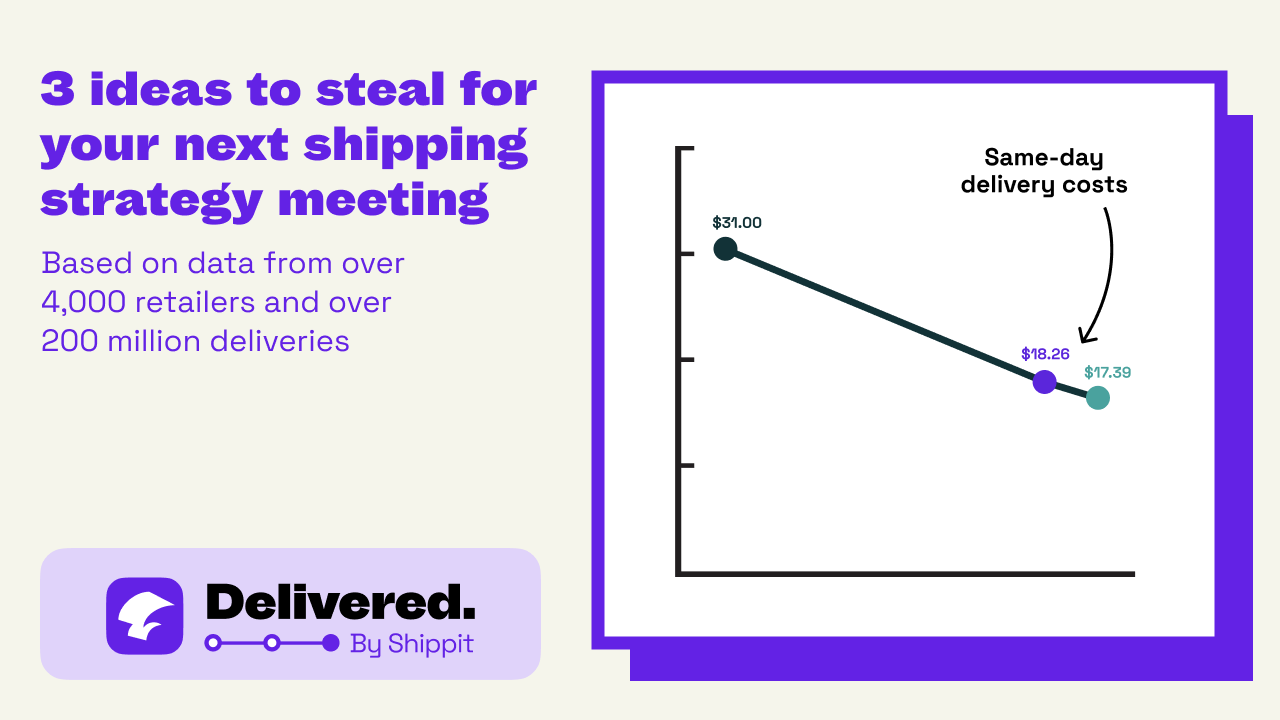
Same-day delivery now costs nearly half what it did in 2018.
That’s just one of the insights from this year’s State of Shipping report — our annual snapshot of the trends, data, and decisions shaping delivery across ANZ.
The report is being used by notable brands to benchmark performance, shape strategy, and get ahead of where the market is heading. You can download a copy here.
During our deep dive webinar, our Co-founder and Joint CEO, Rob Hango-Zada breaks down what the data is really telling retailers.
For our first edition of Delivered, we go deep into the report and look at:
→ What customers are expecting
→ How shipping costs are changing, from 2018 to now
→ Where fulfilment is heading
→ And why the next big opportunity might be hiding just 15km away
Let’s get into it.
TL;DR
- Same-day delivery as a differentiator: Same-day delivery costs dropped 44% since 2018 (from $31 to $17.39) thanks to customer demand. It’s never been cheaper to make fast shipping your point of difference.
- Could in-store fulfilment be the path to unlocking more revenue? Ship-from-store is delivering 10% freight cost reductions for retailers like Rolla’s. A great way to unlock more inventory, and improve delivery speed and costs.
- Supply chain optimisation investment is a priority: We found that 20.7% of retailers identified supply chain optimisation as their top investment area in 2025. If you’re not also prioritising supply chain, could you be falling behind?
Why you need to look at same-day delivery
Delivery costs are rising in 2025 but not as sharply as you might think.
The average standard delivery cost in Australia now sits at $10.39, up slightly from $10.26 last year. Express delivery has also crept up, now averaging $14.69, compared to $14.24 in 2024.
New Zealand’s numbers are slightly lower, $9.70 for standard, and $14.10 for express, both in Kiwi dollars. So yes, costs are rising, sure, but slowly. No shock to the system.
But here’s where it gets interesting. Same-day delivery is going the other way. It’s dropped from $18.26 to $17.39 in just the last year. And if you rewind to 2018, that number was $31.
📊 Data Point: Same-day delivery costs dropped from $31 (2018) to $17.39 (2025)
🎯 Strategic Implication: Same-day is now only $2.70 more than express delivery. If you're not piloting same-day in your top metro markets, are you missing a cost-effective differentiation opportunity?
Our take on this trend: That’s not just a pricing quirk but a shift in how delivery actually works.
Same-day costs are falling because the surrounding infrastructure is advancing fast. To zoom in on this, Rob explained that we’re seeing better route density through smarter batching and more on-demand drivers covering smaller, more concentrated zones. That means less time in traffic, fewer wasted trips, and more parcels dropped in one run.
But it’s not confined to how many parcels you can squeeze into a route. It’s about demand. Consumer appetite for same-day delivery has grown, and that volume helps carriers make the numbers work. In other words, it’s not more expensive to offer same-day, it’s now more economical at scale.
With the likes of Amazon setting the bar, every other shipping experience is under fire to deliver more transparency, faster turnarounds and lower rates. That pressure has made same-day delivery more efficient across the board, and it gives retailers more reason to seriously consider it, especially if they’re sitting on inventory within reach of the customer.
For retailers, this shift opens up new possibilities: Same-day delivery is no longer a luxury; it's an expectation of shoppers who are increasingly seeking speed and convenience.
But what about free shipping?
Free shipping: 69% of retailers still offer it despite rising thresholds
Free shipping is becoming less available:
- From 2018 to 2025, the number of Aussie retailers offering free delivery dropped from 81% to 69% in Australia
- Only 4.8% of Aussie and 6% of Kiwi retailers offer fully complimentary shipping with no strings attached
To make matters trickier:
- Free shipping thresholds in 2025 now sit at $123 AUD on average in Australia, compared to $120 in 2024
- For New Zealand, it’s at $116 NZD
So shoppers are being asked to spend more for a benefit they once took for granted.
Still, there’s a plot twist.
When asked about investment priorities for the year ahead, one-third of retailers said they’re investing in free delivery. That tells us some retailers are doubling down, trying to stay in the race as consumer expectations harden and international brands keep raising the bar.
Nicola Clement pointed out that it’s about giving shoppers certainty. “Your last great experience becomes your new minimum expected experience,” she said. And that means brands have to deliver on predictability and transparency, not just velocity.
Kristin Mumme, Operations Manager at R.M.Williams, backed this up. Her team recently brought on a new carrier and introduced express shipping not just to move faster, but to give customers more visibility, better notifications, and a smoother post-purchase journey.
And then there’s the cost equation.
Rob noted two contrasting examples:
→ One retailer can pick, pack, and dispatch from store in under 5 minutes, delivering in just 38 minutes when shipping on-demand
→ Another operates on a 3-day SLA from store dispatch, pushing everything through express and taking up to 5 days to land the item
The difference is in operational efficiency, not courier speed. So yes, delivery costs are rising but when same-day is executed well, it’s becoming the smarter, cheaper play for retailers who can make it work.
So the question is no longer should you offer free shipping but rather, can you afford not to?
Local commerce is a superpower for omnichannel retailers
15% of all deliveries on Shippit’s platform travel less than 15km from distribution to delivery.
What’s driving this?
“Retailers winning market share are the ones who treat shipping like a core part of the customer experience, not an afterthought. That’s where ship-from-store comes in. It’s an opportunity to stand out by delivering faster, more localised, and more exceptional experiences customers remember.”
📊 Data Point: 15% of deliveries travel less than 15km from origin to destination
🎯 Strategic Implication: If you have stores within 15km of your high order-density postcodes, you're sitting on untapped fulfilment capacity that could reduce costs and delivery times simultaneously. Is your store network the secret sauce to revenue growth?
What we’re seeing now is a shift, a move toward local inventory, local demand, and local fulfilment. Shoppers want convenience without the wait. Fast, free, reliable - those three words are now table stakes. And the retailers delivering on that (literally and figuratively) are the ones taking market share.
The rise of same-day delivery, click & collect, and other fulfilment experiences is about certainty. And that certainty comes from being close to the customer.
The report found that 1 in 5 ANZ retailers are looking to invest in ship-from-store.
Ship-from-store has become a superpower for many retailers. Here’s how it works:
- A store doubles as a mini distribution centre (micro-fulfilment).
- Online orders get fulfilled from physical retail stock, not just the warehouse.
- The item ships directly to the customer from the nearest eligible store, skipping long-haul carrier routes entirely.
Rob highlights that this as a foundational shift not just for delivery speed, but for how retailers manage inventory and serve customers more profitably.
Enterprise shipping platforms like Shippit support this through integrations with order management systems like NewStore, giving retailers visibility into store inventory, and routing orders through the best location, whether that’s a warehouse, a metro hub, or the store itself – no matter how complex the logistics may be.
Here’s how two brands are putting that into practice:
Activated ship-from-store across its store network to unlock inventory and improve pick-and-pack speed by 50%.
Results:
- 10% reduction in freight costs
- 75% drop in non-stocks
- 50% faster in-store pick and pack
- Fewer WISMO enquiries and happier customers
→ DECJUBA
Results:
- Faster delivery and flexible service options
- Reduced pressure on the central warehouse
- Improved conversion and loyalty through better delivery experience
Both brands used smarter routing to allocate orders based on store proximity, stock levels, and shipping cost, making same-day and next-day delivery feel seamless.
Of course, not every store needs to do it. Retailers are moving toward hybrid setups: a mix of high-volume DCs and strategically selected stores fulfilling local demand.
📊 Data Point: Rolla's achieved 10% freight cost reduction with ship-from-store
🎯 Strategic Implication: Ship-from-store isn't just about speed - it's a cost optimisation play. If you have 5+ stores, the ROI case is likely there. Start with your highest-volume stores in metro areas.
It’s no longer about choosing between centralised vs decentralised fulfilment but about building a smarter, blended network that meets customers where they are, often just a few postcodes away.
And for many brands, that’s exactly where the next advantage is hiding.
The top investment for 2025 is supply chain optimisation
Nearly one in five retailers are putting their money into supply chain optimisation – the number one choice for the retailers we surveyed – which, in practice, means putting dollars behind smarter fulfilment systems, faster delivery capabilities, and tighter inventory workflows.
That’s a big shift from 2024, where supply chain didn’t even make the top three. Now it’s jumped straight to the top.
So what changed?
More retailers are recognising the critical role that fulfilment plays in shaping the entire customer experience. If you want to offer same-day delivery, keep up with returns expectations, and build loyalty on fast, predictable delivery – fulfilment is now front and centre.
Rob called out one of the big blockers: most retailers aren’t using their delivery data.
In fact:
- Just 1 in 3 use delivery data to reduce costs or improve experience regularly
- The rest are “leaving insights and dollars on the table”
But when they do, it works. Baby Bunting is proof. With Shippit, they activated online fulfilment from 100% of stores across Australia and New Zealand. They used delivery data to flex volumes, cut costs, and improve CSAT all while expanding into new markets.
This is what smarter fulfilment looks like in practice: connected stores, real-time insights, better delivery performance.
“We wanted to delight our customers and exceed their expectations, with a minimal increase in costs. We were seeing that our customers continued to shop with us, with a steady growth in our loyalty members.”
Retailers are investing in the future of how they operate and that future depends on getting fulfilment right. Smarter, more connected and built around the customer.
Logistics and ops leaders: 3 things you need to note
So, what now?
✅ Fast + free is the new normal Free shipping is declining but continues to be important. Expectations around delivery speed and reliability are on the rise, while same-day is becoming the baseline, not a bonus.
✅ Local matters more than ever 15% of orders already travel under 15km from distribution to delivery. The smartest retailers are moving stock closer to customers and using ship-from-store fulfilment to make it happen.
✅ Fulfilment is your edge It’s not just operations but your strategy. Brands that use their delivery data well are saving more, delighting customers, and growing faster.