Fast delivery won peak
Published 11/12/2025
Fast delivery won peak; it’ll define success in 2026 too

Subscribe to Delivered.
With festive delivery cut-offs looming, Australia’s logistics network is in overdrive.
Billions of dollars of ecommerce orders are flowing from thousands of retailers to millions of consumers.
Amongst the end-of-year chaos, one thing is clear: Australian shoppers have a need for speed.
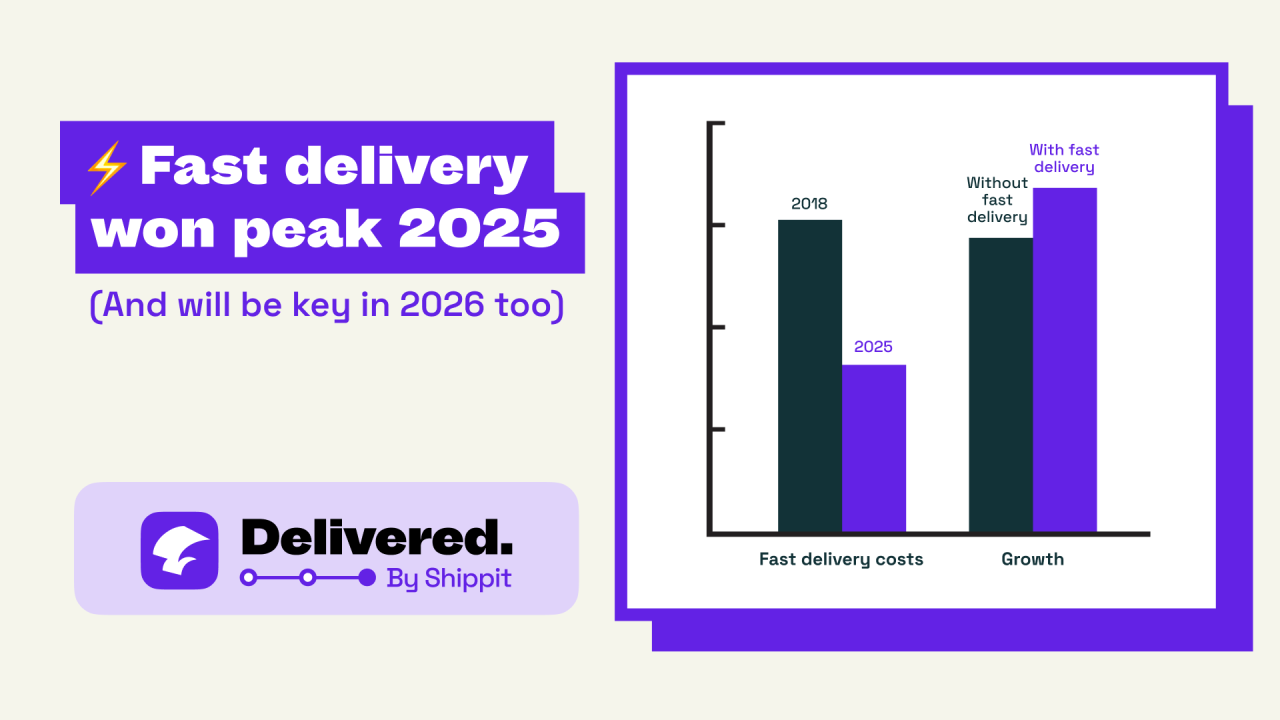
According to Shippit data, retailers offering same-day or next-day delivery grew 3.5-4% faster during the Black Friday, Cyber Monday weekend.
Fast delivery didn’t just win peak, it’ll dictate 2026’s winners too.
The question isn't whether to offer it, but how retailers can offer it in the smartest, most strategic and cost-effective way possible. In the last Delivered of 2025, we’ll unpack one of the biggest trends for 2026: fast delivery.
TL;DR
- Fast delivery = faster growth: Retailers offering same- or next-day delivery grew 3.5-4% faster during BFCM, with 27.6% of retailers now citing it as the biggest driver of cart conversions and loyalty.
- It's more affordable: Same-day delivery costs have halved since 2018 (from $31 to 17.39), and delivery speeds have improved from 2.6 days in 2023 to 1.7 days in 2025.
- Fulfilment is the bottleneck: Most retailers promise 5.2 days but actually deliver in 1.7 days. The gap is costing conversions, and slow fulfilment and underpromising in order to over deliver is the problem.
2026 is an inflection point for fast delivery
When asked what will impact cart conversions and long-term loyalty most in the next 12 months, retailers didn’t say price, product range, or discounts.
Instead, 27.6% said fast delivery options would have the biggest influence on acquisition and retention. But what do we mean when we say fast delivery?
Fast delivery encapsulates methods like on-demand, same-day and next-day delivery. It requires not only fast delivery, but fast fulfilment, so orders are processed and picked-and-packed quicker than standard delivery.
This shift is being driven by younger shoppers, with more than half (51%) saying their delivery expectations have risen over the past year. These digital-natives expect free returns, click-and-collect, tracking and, yes, faster delivery.
As they become both a bigger proportion of the buying population and shop online more than other demographics (1.8x more, according to our data), their need for speed will become more influential.
And there’s a reason why they expect it.
Amazon has fundamentally raised the bar.
With rapid fulfilment networks, an expanding geographic footprint and services like Prime, it has created a new baseline that Australian shoppers now expect from everyone. Alongside Temu and Shein, it is projected to command more than a third of Australian e-commerce in 2026.
Decision-makers across Australian retail, from logistics and operations to ecommerce and finance, are feeling the pressure. The vast majority (82.8%) are now concerned about these international giants (up from 54% in 2024).
When asked where they're losing ground, 39.4% pointed to faster shipping times.
So if fast delivery is a defining battleground in 2026, how do you offer it without breaking the bank?
Fast delivery is more affordable than you think
Offering fast delivery doesn't have to break your budget. In fact, it's becoming more economically viable than ever.
Same-day delivery costs have nearly halved in recent years, dropping from $31.00 in 2018 to just $17.39 in 2025 according to our research.
As more retailers and carriers embrace fast delivery, their cost to serve and capabilities continue to improve.
“That’s really because of delivery density,” says Nate Elias, Shippit’s Senior Shipping Solutions Manager. “More people ordering from the same stores, in the same postcodes, creates density. Fewer stops means better efficiency and lower cost.
“Speed is becoming a baseline expectation across most verticals.”
Carriers aren't just getting faster - they're getting more reliable, with delays dropping from 15.7% in 2023 to 7.7% in 2025.
But here's where it gets strategic: you don't need to offer same-day delivery everywhere to everyone.
The smartest retailers are approaching fast delivery with precision, identifying which categories and customers require speed, then building the right infrastructure to deliver on that promise.
Consider Australia's leading pet retailer Petbarn, for example.
It recognised that for urgent pet supplies - from restocking cat food, to replacing a lost dog lead, or getting medication quickly - customers actively seek out fast delivery options.
By integrating ship-from-store capabilities across 240 locations and using intelligent multi-carrier selection, Petbarn could offer two-hour delivery where it mattered most.
As a result, customers who choose on-demand delivery now spend 3.5 times more and shop 35% more frequently.
It proves that when implemented smartly, fast delivery doesn't just improve customer experience, it drives profitability. By making and keeping promises at checkout, Petbarn has proved that delivery is a growth engine not a cost centre.
The gap between delivery promise and delivery performance is where many are leaving money on the table.
Close the promise-performance gap
In 2025, retailer-advertised delivery estimates - which include fulfilment time - average 5.2 days.
But actual delivery speeds tell a different story. The average delivery takes just 1.7 days.
That's a significant gap between what retailers are promising and what they're delivering. Many retailers are intentionally under promising so that they can over deliver. They would rather deliver an item faster than expected, than slower.
But that hurts conversions. Think about that at checkout. A customer is comparing a similar product at a similar price at two retailers. Both can deliver within 1.7 days, but one says that and the other says five business days. Only one retailer wins that sale.
Closing that promise gap isn't just about updating your checkout messaging. It requires fixing what's actually slowing you down: fulfilment speeds.
Fulfilment is now the bottleneck
Orders sitting in warehouses or on store shelves waiting to be picked, packed, and dispatched for 24-48 hours undermine even the fastest carrier networks.
With ship-from-store a growing trend, it will become even more important.
In 2025, the top investment for 20.7% of retailers is supply chain optimisation (covering both fulfilment and delivery). This is a big jump from fourth priority in 2024. This reflects a growing recognition of the importance of delivery and its impact on acquisition and retention.
A further 10.7% said their biggest investment would be in inventory accuracy and visibility; a non-negotiable for brands to unlock their store-based inventory.
Improving fulfilment speeds requires not just technology, but a cultural shift too.
If an online order comes through, it should be treated with the same urgency as an in-store customer. If picking-and-packing can be reduced from days to hours, or from hours to minutes, a delivery can become 1.7 days, not 5.2.
It’s not an immediate change, though; it requires an ongoing commitment.
“It's crucial to ensure you have the right staff on the floor to fulfil orders. Outside ensuring the goods are picked on time is employee training on packaging standards. Whether it's in a box or a satchel, you need to ensure items are packed safely so they don't get damaged in transit and the customer receives their package in the expected condition.”
Fast fulfilment has paid off for much-loved Australian denim brand, Rolla’s by ThreeByOne.
Across nine stores, it streamlined its pick-and-pack rate by 50%. It also cut non-stocks by 75% and was able to route orders from other locations if an item wasn’t in stock; particularly important when volumes - and stakes - are highest.
“Ship-from-store orders make up about 15% of our orders, but during peak it lifts to 30%. We were able to unlock a lot of inventory that was sitting in-store [during peak] so we could better meet our customer demand,” says Jacqui Devereux, eCommerce Manager at Rolla’s.
“We can now offer premium delivery services for all our customers. It’s all done for store teams in the back end.”
By automating much of the process and setting a new precedent on pick-and-pack speeds, Rolla’s also reduced freight costs by 10%, proving that speed and cost-efficiency can go hand-in-hand.
Turn fast delivery into your competitive advantage in the new year
When January rolls around and your post-peak audit and 2026 planning begins, fast delivery should be high on the agenda.
Audit your current state
Pull your actual delivery performance data from 2025. What percentage of orders are delivered next-day vs 2-day vs 3-day vs 4+ days? What's your current promise vs actual performance gap? Which postcodes, regions or freight types are you fastest in? Map your current delivery costs by speed tier and identify where same-day or next-day is already cost-effective.
Build your strategy
Conduct an inventory positioning audit. Where is your stock today? What percentage of orders were fulfilled from the closest location? Map which carriers can deliver same-day in which areas, and define your 2026 delivery promise based on what you can realistically deliver. Be bold where it makes sense (metro areas, high-density postcodes) and conservative where you need to be.
Set a cultural tone
Faster fulfilment can drive disproportionate gains, but only if the right culture and training is in place. Ensure staff are well trained on pick-and-pack standards, then consider setting a service-level agreement (SLAs). A cultural shift - with the right training - could be a very cost-effective way to improve delivery speeds, bottom lines and customer satisfaction.
The path forward
Fast delivery won Black Friday, because it's what customers increasingly expect and what competitors are normalising.
The trend is here to stay. Same-day delivery costs have nearly halved. The infrastructure and investments are in place. The customer expectations are real.
The question for 2026 isn't whether fast delivery matters, it's whether you'll use the months ahead to address the promise-performance gap, fix fulfilment bottlenecks, and turn delivery into a competitive advantage - before you get left behind.