Peak shipping survival guide
Published 4/9/2025
Peak season shipping: what separates retailers who thrive from those who don’t

Subscribe to Delivered.
Peak season is the moment of truth. It exposes which retailers treat delivery as a growth engine and which ones hope their systems can hold together under pressure.
And did you know that holiday 2024 retail sales hit US$1.05 trillion, with ecommerce alone driving $380 billion? Peak is the revenue lifeline of the year. This year’s State of Shipping report shows the pressure is mounting. With 1 in 2 younger shoppers saying their expectations have shifted as a result of Amazon and Temu, the impetus for retailers to adapt has never been greater.
The data tells the story: while retailers promise 5.2 day delivery estimates, actual delivery times are taking just 1.7 days on average. Yet two-thirds of retailers still don’t use delivery data to tighten operations. That gap is a window into who’s ready for peak and who isn’t.
From his seat at Shippit, where he works with major retailers every day, Enterprise Customer Success Manager Piotr Gosk draws on 25 years in supply chain to explain what’s changed: shoppers now expect not only speed, but convenience on their terms. Late-night drops, post-school package pickups, or knowing their parcel will arrive before Christmas no matter what – that is what makes or breaks their peak season shipping experience.
TL;DR
- Winners stop chasing margin on freight:They focus on cost recovery and reward loyalty customers with faster or free delivery, boosting program participation and long-term value.
- Peak orders don’t look like your normal orders: Basket sizes jump 100 - 200% or more, pushing retailers to rethink fulfilment, packaging, staffing, and inventory buffers, not just simply to be able to handle higher volumes.
- Reliability comes from preparation, not firefighting: Leading retailers plan months ahead with carriers, set realistic promises, and keep communication constant through peak. They adjust expectations and offer options like click-and-collect when needed.
- Speed isn’t enough when customers want control: Customers want deliveries after 5pm, package pickups after school, or even late-night drops. Retailers that adapt to these patterns build stronger trust than those who only chase faster transit times.
Winners measure shipping in repeat customers, not $$
“From my past experience in retail, we didn’t look to make necessarily a profit on the freight profile. We looked to recoup the costs,” says Piotr.
It’s a subtle but important distinction. In his experience, retailers who stop chasing margin on freight free themselves to focus on what actually drives loyalty: service that feels fair and reliable.
And that’s where the winners go further. Instead of treating every customer the same, they use peak as a chance to reward their best segments.
“When I worked in retail we would really try to reward them as best as we could… for example, we would offer on-demand services to our loyal customers,” Piotr explains.
In practice, that means loyalty programs unlock delivery perks such as:
- Free shipping thresholds: for members who hit certain spend levels.
- Upgraded delivery speeds: (e.g. express instead of standard) at no extra cost.
- On-demand or same-day delivery: reserved for top-tier customers.
Piotr has seen these strategies consistently lift uptake in loyalty programs, proof that the delivery experience itself can be the reward that keeps customers coming back.
Meanwhile, some retailers still treat freight as a profit centre. That short-term mindset puts them in a race to the bottom. The winners see delivery differently, not as a cost line, but as a loyalty play that pays off long after peak.
👉 Data Point: 82.8% of retailers are now concerned about Amazon and Temu’s growing dominance, up from just 54% in 2024.
👉 Strategic Implication: Winners don’t try to undercut Amazon on price. They lean into delivery as their edge, using shipping as proof of loyalty and a reason for customers to return.
Leading retailer know that trust converts better than discounts
Peak season doesn’t just stretch your operation but reshapes it as well.
As Piotr put it, basket sizes don’t creep up in peak, they blow up. Orders double or even triple, and suddenly the whole system feels different. Bigger baskets mean multiple items in play, more split shipments, heavier parcels, and packaging lines under stress. Retailers that only forecast “more” orders miss the reality that these are different orders.
That shift is powered by something subtle but critical and that is, customers now believe the promises that retailers make at checkout or on product pages. Piotr sees shoppers buying online with a confidence they didn’t have a few years ago, trusting they’ll get the right size, the right colour, and that it’ll land when the retailer said it would. That belief is what pushes them to load bigger carts from the couch instead of hedging their bets with an in-store visit.
But it’s not just trust in speed. The customer’s definition of convenience has changed. They want deliveries after 5pm, aligned to school pickups, and even late-night drop-offs when they are at home. Retailers who still treat “fast” as the only metric are missing the new standard: fit my life, not just my clock.
Harvey Norman leant into this shift directly. By rolling out same-day and even three-hour delivery windows, they gave customers control over timing and improved conversion by 11% while cutting fulfilment time by 88%. It’s a reminder that meeting convenience expectations is about shaping delivery around how customers actually live.
The numbers make it clear: 64% of customers say they won’t shop again after a poor delivery experience. In peak season, when emotions run high, the retailers who come out on top treat every promise as a contract; measured, monitored, and delivered against in real time.

Winners turn data into promises customers can trust
“Retailers I work with are seeing basket sizes significantly increase compared to previous years,” says Piotr. “We’re talking 100-200%+ improvements, if not far greater, during peak.”
That kind of surge changes the rules. Larger baskets mean multiple items moving in parallel, more split shipments across carriers, and a packaging process that suddenly feels industrial rather than retail. The retailers who only model “more orders” get blind-sided by orders that are fundamentally different.
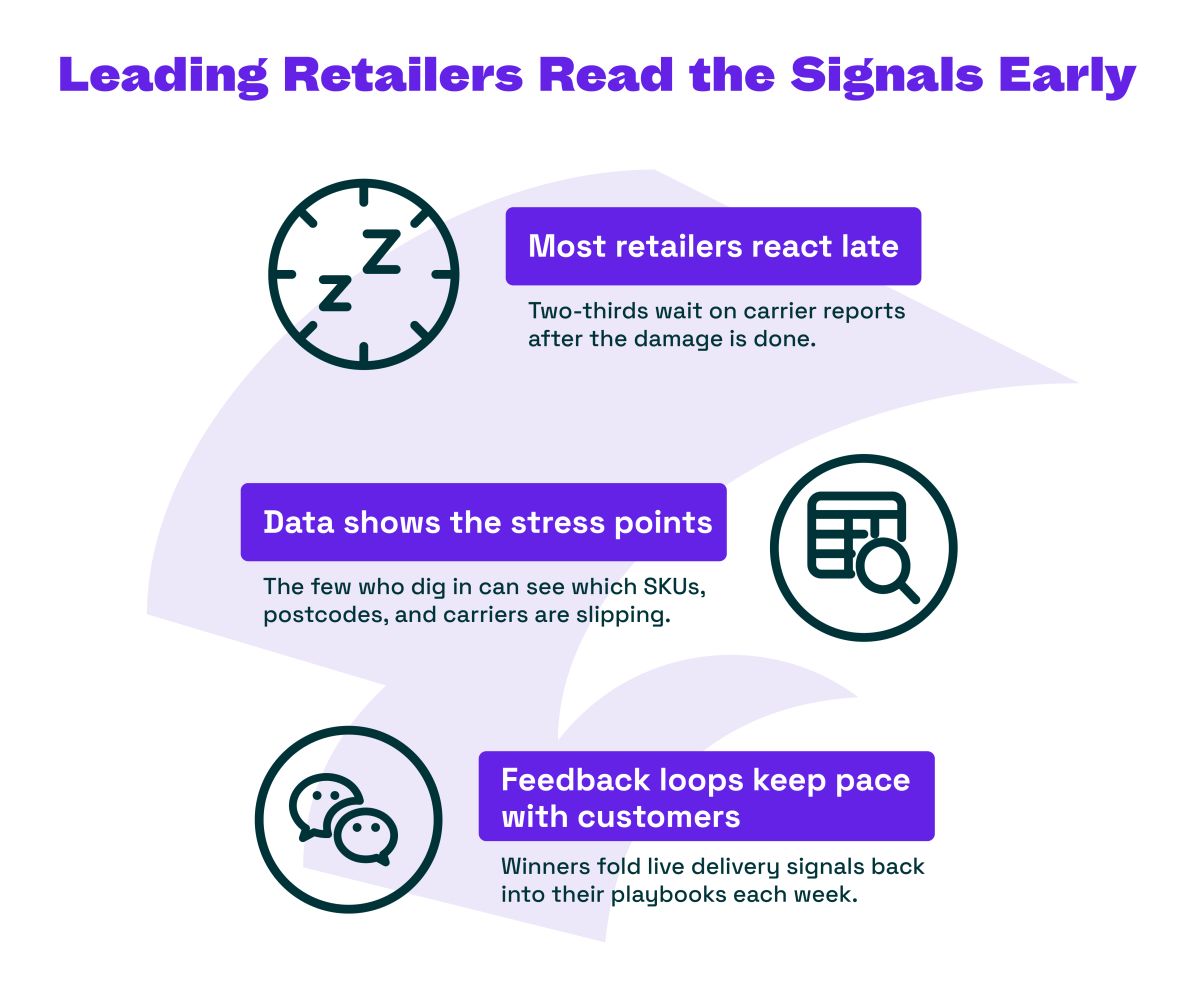
This is where Piotr sees data come in. Most retailers are still working off carrier reports that land fortnightly or monthly. By the time they notice late scans or missed deliveries, the customer has already felt the failure. The sharper operators are watching in real time:
- Which SKUs are consistently driving multi-box shipments.
- Which postcodes are pushing the limits of their delivery promises.
- Which carriers start slipping the moment volumes spike.
That visibility lets them set promises they can actually keep, and keep adjusting them as the season unfolds.
The winners respond with operational detail:
- Dynamic packaging standards → tuned to keep larger, heavier parcels intact through multiple handoffs.
- Trained peak staff pools → flexible labour that can be deployed without draining the shop floor.
- Inventory buffers on core SKUs → so web demand doesn’t cannibalise in-store sales.
- Live performance scorecards → weekly, if not daily, views of carrier reliability by lane, SKU, and promise window.
👉 Data Point: 2 in 3 retailers rarely or never use delivery data to optimise operations.
👉 Strategic Implication: That means most are reacting to customer shifts after the fact. The few who dig into their delivery data are the ones seeing patterns early, which SKUs are driving split shipments, which postcodes need different cutoff times, and which carriers slip under stress. They are folding live signals back into their playbooks, week after week. In a season where baskets swell and convenience expectations tighten, that kind of feedback loop is what separates those who keep pace from those who fall behind.
The operational realities most retailers underestimate
While strategy sets the tone, peak season success is decided in the trenches. Execution under pressure is where the cracks show and Piotr has seen that the cracks are remarkably consistent.
When carriers hit capacity limits
“When there is an issue with shipping services, it’s not the carrier customers blame, it’s the brand,” says Piotr.
That truth is brutal for retailers who hope their carrier can absorb the pressure without contingency plans. The smarter operators accept that capacity crunches are inevitable and start cutting their cloth early: rebalancing volumes between carriers, shaping demand with cut-off dates, and reserving premium services for high-value customers.
“Retailers need to deliver 100% of their parcels to all of their customers in preparation for Christmas. Put yourself in their shoes: you’ve purchased something online, whether it’s for your kids or whether it’s for your partner, and that package doesn’t arrive for Christmas. You would be absolutely devastated.”
Why data-driven planning wins
Too many retailers still plan peak on outdated rhythms. As Piotr pointed out, it’s important for retailers to use data-driven insights to anticipate delivery challenges before the damage hits the customer.
And it’s not just about dashboards. Real preparation means:
- Scenario modelling → adjusting promises if one carrier starts slipping, and being prepared with a back-up plan (such as switching to alternative carriers through their multi-carrier rules).
- Tiered cut-offs → staggering standard, express, and on-demand windows to preserve reliability.
- Continuous check-ins → Piotr emphasised how top retailers speak to carriers daily during peak, not quarterly, to catch cracks before they become failures.
The difference is invisible until it matters most. To the customer, it looks like a gift arriving on Christmas Eve exactly as promised. To the retailer, it’s months of quiet contingency planning paying off when everyone else is scrambling.
👉 Data Point: Delivery delays have dropped from 15.7% of orders in 2022 to just 7.7% in the past 12 months.
👉 Strategic Implication: That drop didn’t come from luck. It came from retailers who’ve started measuring, and carriers who have improved their operations across the board. Some carriers are using route optimisation technology to act on signals in real-time, while the introduction of new on-demand carriers is also helping drive down delays.
Logistics and ops leaders: Your strategic action items
✅ Make shipping an acquisition strategy, not a cost centre: As Piotr said, the goal isn’t profit on freight but cost recovery. Winners review pricing annually against market benchmarks, then use delivery perks as loyalty rewards. That can mean free shipping thresholds, faster shipping upgrades, or on-demand access for top-tier members. The payoff is higher loyalty uptake, not necessarily a freight margin.
✅ Plan for structurally different peak orders: Baskets transform. A single order can splinter into multiple shipments, stressing packaging lines and increasing risk of frustrating customers. Winners build training refreshers for staff on proper packing, run scenario drills for split orders, and set inventory minimums so online sales don’t wipe out in-store availability of core SKUs.
✅ Close your delivery promise gap with real data: Many retailers are still stuck with carrier reports on fortnightly or monthly cadence. By then, it’s too late. Leading retailers pull performance data daily, by SKU, postcode, and carrier lane and adjust promises in real time. That’s how you move from a blanket or range-based estimate to a postcode-specific promise you can actually keep.
✅ Build resilience through year-round carrier relationships: Piotr described retailers who run daily catch-ups with carriers during peak and monthly reviews outside of it. Those conversations go deeper than rates; they cover capacity crunches, late-scan patterns, and which services to cut back before customers feel the failure.
✅ Never trade safety for speed: Peak is when corners get cut, drivers are overextended, staff are rushed, or safety checks get skipped. One serious safety slip costs more than any missed delivery window. Winners bake safety standards into their KPIs so the warehouse and fleet don’t compromise under additional load.
✅ Fix the checkout before the warehouse: Customers drop off at the point of purchase, not the dock door. Piotr compared it to walking into a store where you’re immediately greeted with music, a distinct scent and get to enjoy the whole experience. Online needs the same. That means order management systems that show accurate stock, multiple delivery options at checkout, and clear cut-offs. A clean checkout often delivers more ROI than another conveyor in the warehouse.