The hidden cost of not knowing
Published 19/3/2026
The gap between the data haves and have nots is widening fast - closing it is critical


Subscribe to Delivered.
Two logistics leaders sit down to review the same 12 months of delivery data.
The first sees volatility. Peak season was messy, costs crept up, a couple of carriers underperformed. They write it off as a tough year and start planning for next peak.
The second sees something different. Two preventable margin leaks. A carrier lane leaking costs, and a fulfilment routing decision that was adding 200km to orders that could have been dispatched from a store 8km away.
Combined, they're worth hundreds of thousands of dollars.
Both logistics leaders are data-rich, but only one is insights-rich.
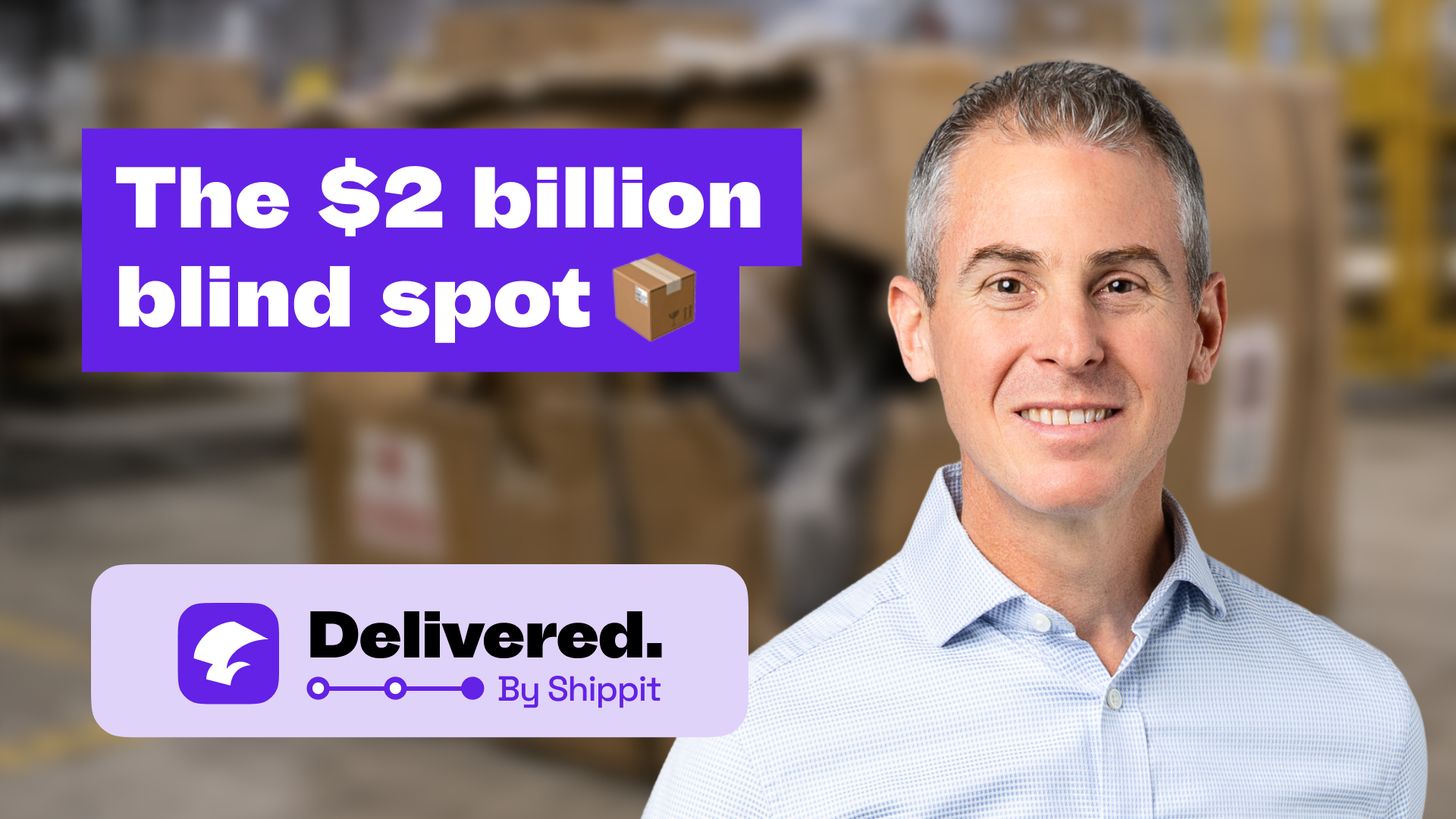
In this week’s Delivered, Shweta Murdeshwar - Enterprise Technical Account Manager at Shippit - explains why this is the defining split in logistics operations right now, and why it’s widening faster than most retailers realise.
TL;DR
- Only 1 in 3 retailers use their delivery data to optimise operations, reduce costs or improve customer experience - leaving 2 in 3 exposed;
- The most effective operators have shifted from descriptive (what happened?) to diagnostic and predictive intelligence (why did it happen, and what's about to?);
- Those yet to unlock their data will be the most vulnerable to rising customer expectations, intensifying competition, and surging insolvencies.
Data-driven logistics used to be aspirational, now it's a requirement
The stakes have never been higher.
Retail insolvencies are surging, with businesses closing 31% more often so far in FY26 compared to FY25, and nearly 50% more than FY24.
It’s not just small or unestablished brands that are struggling; iconic brands like Catch, Barbeques Galore, Jeanswest, and Rivers have closed their doors in the last 12 months.
And against that backdrop, Amazon, Temu, and Shein are projected to control 36% of local ecommerce by the end of 2026, and 50% by 2030.
As they grow, so too do consumer expectations.
Two in three Aussies wouldn’t return to a retailer after a poor delivery experience, according to Shippit research. Four in five say delivery is important in their purchasing decisions.
So if delivery experience is so influential to retention and acquisition, why are just 1 in 3 retailers actively using data to optimise operations, reduce costs, or improve experiences? And why are the other two in three leaving decisions to gut feel, outdated reports, and reactive firefighting?
“The gap between the data haves and have nots is widening fast,” Shweta says. “Two years ago, data-driven logistics was aspirational. Today, it's a critical requirement. And yet most retailers still can't tell how their carriers are performing by lane.”
The problem isn't data shortage, it's fragmentation and usage
Ask most logistics leaders why they're not using their data more effectively and the honest answer isn't that they don’t have enough data. It's that the data is everywhere - email, CRM, their ecommerce store or the dispatcher's head - and nowhere useful at the same time.
“Information is spread across six to eight different systems. There's no single view. Spreadsheets don't sync with each other. Systems don't talk to each other. Getting that information becomes really difficult. It could be too much data and no framework, and hence nobody pays attention to it."
Or, they’re not looking at it the right way.
Two years ago, a data analyst pulling a monthly carrier performance was progressive. Today, that same report is limited. By the time it lands, the moment to act has already passed.
“Retrospective reporting is like looking in your rear view mirror while you’re driving,” Shweta explains. “It can tell you what went wrong last month. But what's the value in that? That’s not a decision-making tool. Insights-led logistics tells you what to do next.”
“If you know that your DIFOT is at 87%, great,” Shweta continues. “But knowing which carrier, which lane, which dispatch times drove this failure; that is the insight you need.
“The real data advantage would be forward facing. Using your patterns, your logistics, your dispersion data to maybe reposition your inventory, maybe do a check of that before peak times, using carrier cost data to renegotiate with your carriers before contract renewals.”
For retailers who have made that shift, the payoff isn’t just operational - it’s commercial.
Petbarn didn't guess, its data told them
When Petbarn analysed customer behaviour by delivery choice, a clear signal emerged: customers who opted for on-demand delivery were spending around 3.5% more per order and ordering approximately 35% more frequently than customers on standard delivery.
“Petbarn didn't guess that on-demand customers were more valuable. Their data told them that," Shweta adds. “Smart use of data turns shipping from a cost centre into a revenue driver.
“If another retailer wanted to investigate something similar, start by checking your delivery option data segmented by customer behavior. Do customers who choose faster options have higher LTV and repeat purchase rate? What are their basket sizes? Most retailers have this data, but it's not connected to delivery choices. And that's the analysis to run first.”
Freedom Furniture took a similar approach to cost. Using freight dispersion data to map order origins against store locations, it built its ship-from-store rollout around proximity not assumption. Scaling from five to 62 fulfilment centres, it was able to route the right order to the right store, achieving approximately 20% reduction in freight costs.
“Freedom’s success came from understanding through data that they could fulfill orders from stores rather than a centralised DC, cutting the distance traveled and therefore the cost,” Shweta continues.
“The key question for any retailer considering this would be: Where are my orders going? Where is my stock sitting? Run a freight dispersion analysis, find the postcodes which are generating the most orders, then overlay that with where your stores and DCs are relative to these postcodes. If there's a store sitting, say, five kilometers from a cluster of high-demand customers, but you're fulfilling it somewhere from a delivery center which is 500 kilometers away, that's your first ship-from-store pilot location.”
Most retailers already have the data. The gap isn't in collection, it’s in connecting cost data to carrier decisions, delivery choices to customer LTV, and fulfilment locations to order demand. So where should you start?
3 things to action this week
Retailers who look at their data often find 10-15% in freight savings immediately, hiding in plain sight - not through a data scientist to lead complex modelling, but through three simple steps that 2 in 3 retailers haven’t followed before.
Start here:
- Ask yourself a cost question: What is my cost per delivery by carrier, lane, and freight type right now? If you can't answer it in 10 minutes, that's where you start.
- Connect delivery data to customer behaviour: Do customers choosing faster options spend more and buy more often? Most retailers have the data, it's just not connected to delivery choices yet. Run the segmentation.
- Run a freight dispersion analysis: Where are your orders going vs where your stock sits? This single analysis typically surfaces both cost savings and ship-from-store pilot locations.
None of these require a data scientist or a transformational programme; just the data visibility and the ability to ask the question before the moment to act has passed.
“The retailers who are winning aren't just the ones who are offering great prices,” Shweta says. “They are the ones who can see their entire operations, have clear visibility in real-time, and can make decisions before problems or customer complaints arise.”
That visibility isn’t a nice-to-have. In 2026, it’s the difference.
The window isn't closed, but it's closing
With Amazon, Temu, and Shein projected to control 36% of Australian ecommerce in 2026, rising to 50% by 2030, time is running out.
You cannot out-price or out-invest them. But there are opportunities for those who embrace their data, Shweta explains: “You can ‘out-know’ them when it comes to your customer base.
“Data lets you identify who your loyal customers are, where they live, what delivery experience they had and whether they come back.
“That’s your advantage. For retailers who haven't started and aren't willing to change, maybe it's too late for them, but the window isn't closed yet. Retailers who are interested in acting in the next 12 months will define the competitive landscape and they will be at an advantage.”