Stay in the loop
Subscribe to receive the latest email news and updates from Shippit
Australia's healthcare system is under more pressure than it has been in a generation, and the logistics network and fleets supporting it are feeling the strain. In 2023, 17% of the population was aged 65+. By 2050, that’s projected to reach one in four. Not only is the population getting older, it’s getting larger too. Together, these shifts are driving an increase in hospitalisations; placing sustained demand on healthcare infrastructure and the logistics systems behind it.
Pathology services sit at the centre of this surge. More patients, more chronic conditions, and more testing mean a rapidly increasing volume of samples moving between collection centres, labs, hospitals, and even homes - often under strict time constraints.
The challenge for healthcare logistics teams isn’t just scale, it’s precision. When delays or errors occur, the consequences can directly impact patient outcomes. This is where fleet management software becomes essential. The right fleet management software enables healthcare providers to manage time-sensitive deliveries, maintain visibility across complex transport networks, and ensure compliance in high-stakes environments.
But what exactly is fleet management software? And what capabilities are non-negotiable when evaluating solutions for healthcare logistics?
What is fleet management software?
Fleet management software is a digital platform that gives operators centralised control over their vehicles, drivers, routes, and deliveries in real time. At its core, it replaces manual dispatching, paper-based run sheets, and siloed communication with a single system that automates route planning, tracks driver progress, captures proof of delivery, and provides fleet-wide data and insights.
For healthcare and pathology operators, fleet management software needs to do more than the basics. Platforms like NowGo by Shippit use AI-powered route optimisation to take the manual work out of dispatch and delivery; giving operators smarter route recommendations, real-time visibility, and the flexibility to handle complex, time-critical constraints that off-the-shelf freight tools simply aren't designed for.
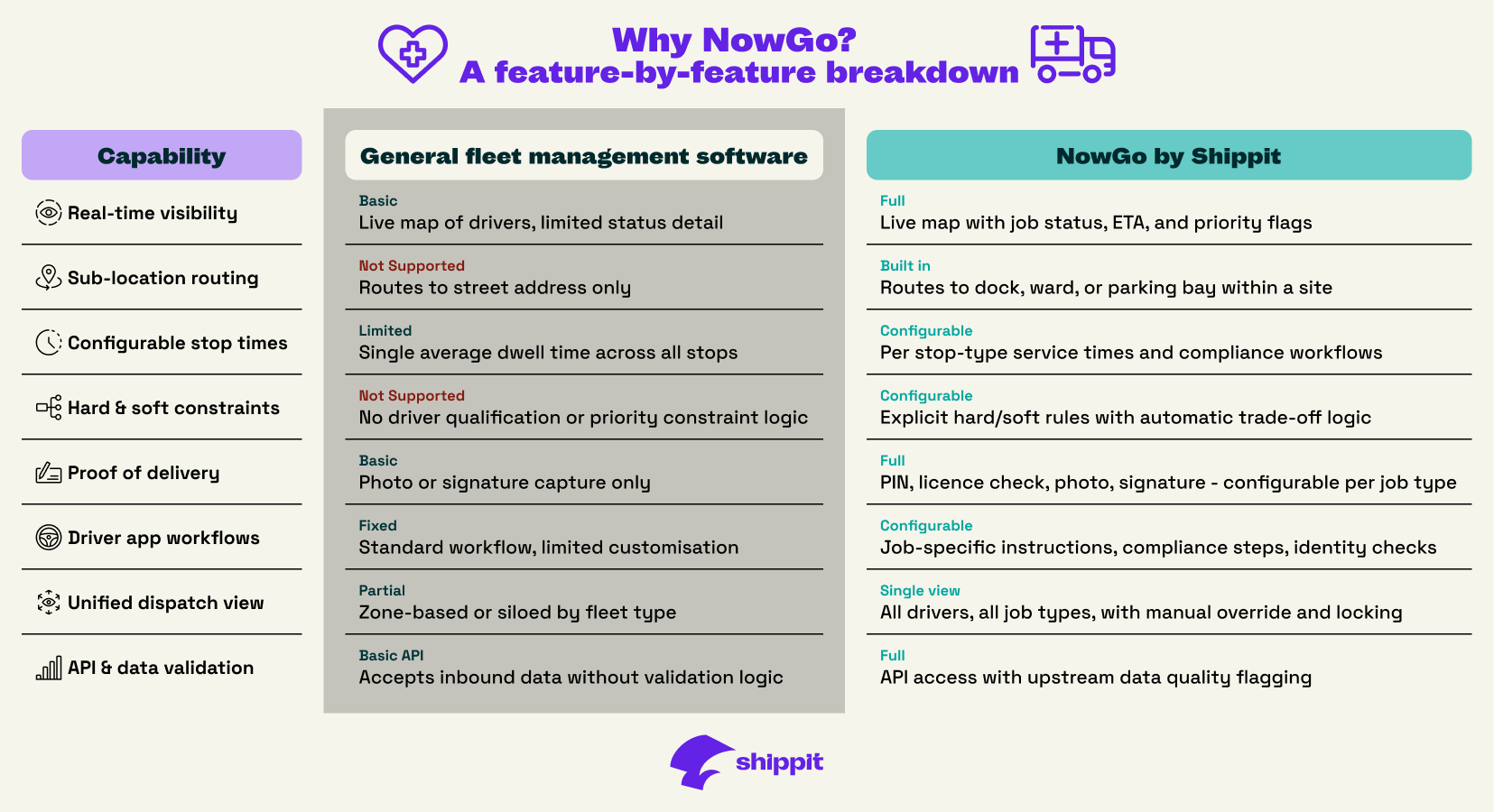
Here are the eight capabilities that separate a healthcare-ready fleet management platform from one that will create as many problems as it solves.
1. Real-time fleet visibility
When a surgeon is waiting in theatre and the courier is inbound, ‘approximate location’ isn't good enough. Real-time fleet visibility gives dispatchers and clinical teams a live picture of where every driver is, what they're carrying, and when they'll arrive.
For healthcare operators running 24/7 services nationwide - from capital cities to remote regional towns - this visibility is what allows a dispatcher to make fast, confident decisions about priority reshuffling; whether that means redirecting a driver mid-route or escalating a sudden or urgent job ahead of everything else. Without it, those decisions rely on memory, phone calls, and guesswork.
2. Fleet management that understands healthcare locations
Most routing software geocodes a street address. For a hospital, that typically means the front entrance. The problem is that hospitals are large, complex sites with multiple wards, loading docks, courier parking areas, and specialist departments spread across buildings that may not even share a street frontage.
The cost of this mismatch adds up fast. A driver routed to the wrong entry point can lose as much as five minutes per stop. Across a run of twelve stops, that's an hour of wasted drive time per-driver, per-day. Scale that across a fleet of 50 drivers and the cumulative inefficiency quickly and significantly erodes capacity and cost.
NowGo by Shippit is designed to route drivers to the correct sub-location within a hospital. Not just the right building, but the right department, the right dock, and the right parking bay. This level of precision is a meaningful operational difference for healthcare fleets where stop accuracy determines service performance.
3. Configurable stop times and service rules
Healthcare deliveries are rarely one-size-fits-all. Consider three drivers on the same fleet: one restocking PPE and basic dressings; one delivering clinical equipment that requires a compliance handover and trained handling; one completing an at-home medication drop that requires age and identity verification before anything is handed over.
These are fundamentally different service types, and a system that applies the same dwell time and workflow to all three will get things wrong. Standard fleet systems typically apply a single average dwell time across all stops. For healthcare operators, this is a critical gap.
Software needs to distinguish between stop types and apply the correct service time for each whether it's a quick hospital drop, a multi-step equipment handover, or a regulated delivery requiring a PIN or photo ID check.
This isn't just about efficiency. One incident involving an unattended medication delivery - where the wrong person signed for and consumed serious prescription drugs - illustrates exactly why configurable proof of delivery workflows exist. Systems that enforce identity verification at the point of delivery protect patients and reduce operator liability.
4. Hard and soft constraint management
Healthcare logistics involves a layered set of rules that a general-purpose fleet system will struggle to replicate. Some constraints are absolute: a driver certified to transport radio pharmaceuticals - used in nuclear medicine and oncology - must be matched to that job; a vehicle equipped with temperature-controlled storage must be assigned to cold-chain freight. These are hard constraints and breaking them isn't an option.
Others are soft, though. It's preferable not to make a standard delivery late, but if an urgent job for a critical patient needs that driver instead, the priority is clear. Fleet management software should allow operators to configure both categories explicitly so the system can make intelligent trade-offs automatically, and so dispatchers know exactly what rules are in play when they're managing exceptions.
5. Delivery performance tracking and proof of delivery
For operators with a 97% DIFOT (delivered in-full, on-time) SLA across thousands of same-day and time-critical deliveries, tracking delivery performance isn’t just a reporting requirement. It's the measure by which you know whether you're meeting your obligations to customers and patients.
Beyond tracking, proof of delivery requirements for healthcare are strict and evolving. Any software evaluation for healthcare logistics should confirm that the platform meets all data residency and compliance requirements, not just for current operations but as regulatory obligations continue to tighten.
Look for a platform that supports configurable proof of delivery workflows (from photo capture and electronic signature, to PIN verification and driver's licence checks) alongside secure storage.
6. Driver app usability and configurable workflows
A fleet management software is only as good as what drivers actually see and do on the road. If the driver app is clunky, slow, or doesn’t work when service is limited, adoption suffers and the operational value of the platform evaporates.
For healthcare fleets, driver apps need to surface job-specific instructions clearly: which loading dock to use, what compliance steps apply, what identity checks are required. Configurable workflow engines, where the app can be adapted to capture different data points depending on delivery type, give operators the flexibility to build compliant and sector-specific processes without asking drivers to mould to a generic platform on the run.
7. Dispatch and multi-location support
Healthcare logistics operations rarely fit a neat geographic grid. A single fleet might service multiple hospitals, pathology collection centres, pharmacies, and patient homes, with jobs arriving ad hoc and in real time alongside pre-planned runs. Managing this from multiple disconnected dispatching screens, or rigid zone-based allocations, creates complexity and expands blind spots.
Fleet management software that supports a unified dispatch view across all drivers and job types - while still allowing dispatchers to apply manual overrides, lock assignments, and sequence runs - provides situational awareness without sacrificing control. Ultimately, the goal is reducing the load on dispatchers without removing their judgment from the equation.
8. API access and integration flexibility
Healthcare operators often work with large enterprise customers who pass booking data through their own systems via API. If fleet management software can't consume that data cleanly - surfacing errors or mismatches before they become delivery failures - the result is bad data governance that flows through to the driver and, ultimately, the patient.
A common example in healthcare logistics is address. For example a customer's system says ‘Mater Hospital, Raymond Terrace, Brisbane'; a valid address. But the delivery should go to the private facility on the next street, not the public hospital. Both are called Mater. The error only surfaces when a driver arrives at the wrong building. When booking data flows in via API, there's no human checkpoint to catch this, unless the software builds one in.
Look for a platform with robust API access and the ability to flag mismatches, surface data quality issues upstream, and give operators the tools to maintain clean data over time. In healthcare, where one wrong address can mean a missed surgery or a delayed diagnosis, that capability isn't a nice-to-have.
Why healthcare operators need purpose-built fleet management software
Pathology networks and healthcare operators work in a unique and regulated environment. One where delivery failures have clinical consequences, compliance requirements are tightening, and the cost of inefficiency compounds across large fleets and hundreds of daily stops.
The eight capabilities above are the difference between a system that manages vehicles and a system that manages outcomes. NowGo is built for the latter.
Want to see how NowGo handles healthcare fleet complexity? Book a demo.