Stay in the loop
Subscribe to receive the latest email news and updates from Shippit
Spring is weeks away. Longer days mean post-work swims, a cheeky gelato, and a lift in construction activity. Sites start earlier, sequence work more tightly, and, of course, order more plant and materials. The onus is on trade supply fleets to handle the surge in volume and pressure. Their ability to do so is dependent on whether they’re working on spreadsheets, legacy systems, or fleet management software built for the surge.
Fleet management software explained
Fleet management software plans, sequences and tracks the deliveries a business makes in its own vehicles. It assigns each job to a suitable vehicle and driver, builds the run, re-plans when the day changes, and gives customers an ETA and proof of delivery. It’s how trade suppliers can make and keep delivery promises across every branch - not just one.
Construction budgets and timelines rely on delivery
Whether it's a billion dollar tower or a bathroom reno, construction projects are judged on two things: time and budget. Nothing influences those two numbers more than having the right labour and the right materials on site at the right time. Imagine an order of pipes arrives at 11am, four hours after your plummer, who needs them before he can start work. It costs your customer a day of labour - and you, potentially, that customer.
Most fleets today still run on humble spreadsheets or legacy systems, neither of which are fit for purpose.
- Manual dispatch: Experienced dispatchers build runs and manage fleets on static spreadsheets, assigning jobs based on local knowledge and driver relationships, and managing communications with a phone in overdrive.
- Legacy platforms: Rigid solutions that have as many functionality gaps as the fleet does vans. Once fit for purpose, they were relegated to ‘subpar’ long ago. Inertia and an aversion to change management is preventing change.
Neither can handle the complexity of a modern-day fleet, or the surge that busy periods provide.
Manual dispatch works, until the moment something goes wrong
Don’t get us wrong, manual dispatch can, and does, work. But the problem is, it’s suited to the ‘perfect’ day, not a realistic one. And it quickly struggles when a fleet starts growing in scale or complexity. A good dispatcher builds a workable run most evenings, that, on paper, seems very appropriate for the following day. But fleets don’t run on paper, they run on the road.
Imagine a 6:30am drop to a Sydney CBD site. Crews arriving, works sequenced, truck loaded, time locked in. Then a vehicle breaks down and adds an hour. The run sheet has no answer for that. The crane booked to unload has another site to reach. By 8am crews stand around, by 9am the crane alone can easily burn in excess of $500 an hour, and by midday the delay has spread to other jobs. This wasn’t out of the ordinary; it was a real and regular occupational hazard for fleets.
Your dispatcher is in damage limitation, rebuilding the plan on the fly while fielding calls for site forepersons, calling other drivers, and second-guessing new delivery windows to appease the customer. That customer has now seen a hit to their budget and timeline, and they’re considering another supplier for their next plant hire or materials run.
Legacy platforms fix yesterday's problems, but not today’s
Legacy fleet software was built for a different operation and a different era: fixed routes, known customers, a plan set the night before and run the next day. Today, every tradie and foreperson has access to hundreds of thousands of SKUs on their smartphone. They expect to be able to place and receive an order for plasterboard, almost as quickly as they do their Friday lunchtime burger.
Orders land all day, sites move, and the promise you made at the point of sale has to survive whatever the day throws at it. Legacy software has many shortcomings. Without a driver app, there's no real-time proof of delivery. Without customer-facing notifications, your customer service team is inundated with phone calls enquiring about urgent orders. And with static routes built on yesterday's data, there’s limited scope to quickly assign new jobs or reprioritise delivery windows.
“For a lot of companies, they have this plan of what today is going to look like, and all the time there'll be something that drops at the last minute,” says Helen Studley, Senior Product Manager, NowGo. “A lot of systems don't route for that efficiently, and it becomes: let's use this extra emergency vehicle to go do that urgent thing that's popped up."
The inertia is understandable. Change management is a challenge and replacing a deeply entrenched platform feels like a project no one has time for. But fleet management software is what enables you to improve efficiency and throughput without adding the extra vehicles, labour, and dispatchers that erode your margins. It’s how you do more with less.
The role fleet management software plays
Fleet management software like NowGo takes the decisions a dispatcher makes on instinct and executes them continuously, with live data and complete visibility, across every vehicle at every branch. It eases the dispatcher's job rather than removing it. They move out of their spreadsheet and into a control tower, conducting an operation they can see end to end.
“We're not here to replace the things dispatchers know,” Helen continues. “It's more to deal with all the day-to-day mundane things they have to think about, and leave them free to deal with exceptions and things out of the norm, rather than plugging the same numbers into the computer every day."
So how is it built for the complex, time-sensitive nature of trade supply delivery?
Vehicle and load matching
Trade supplies are diverse. A 6m length of pipe, a pallet of tiles, and a single tap fitting are three different deliveries. NowGo matches each job to capacity, vehicle type, and handling needs, so a crane truck isn’t allocated jobs a ute could take, a truck isn’t given a load that will see it exceed strict HVNL regulations, and every order is matched to a vehicle that can meet the delivery promise.
Sequencing and routing
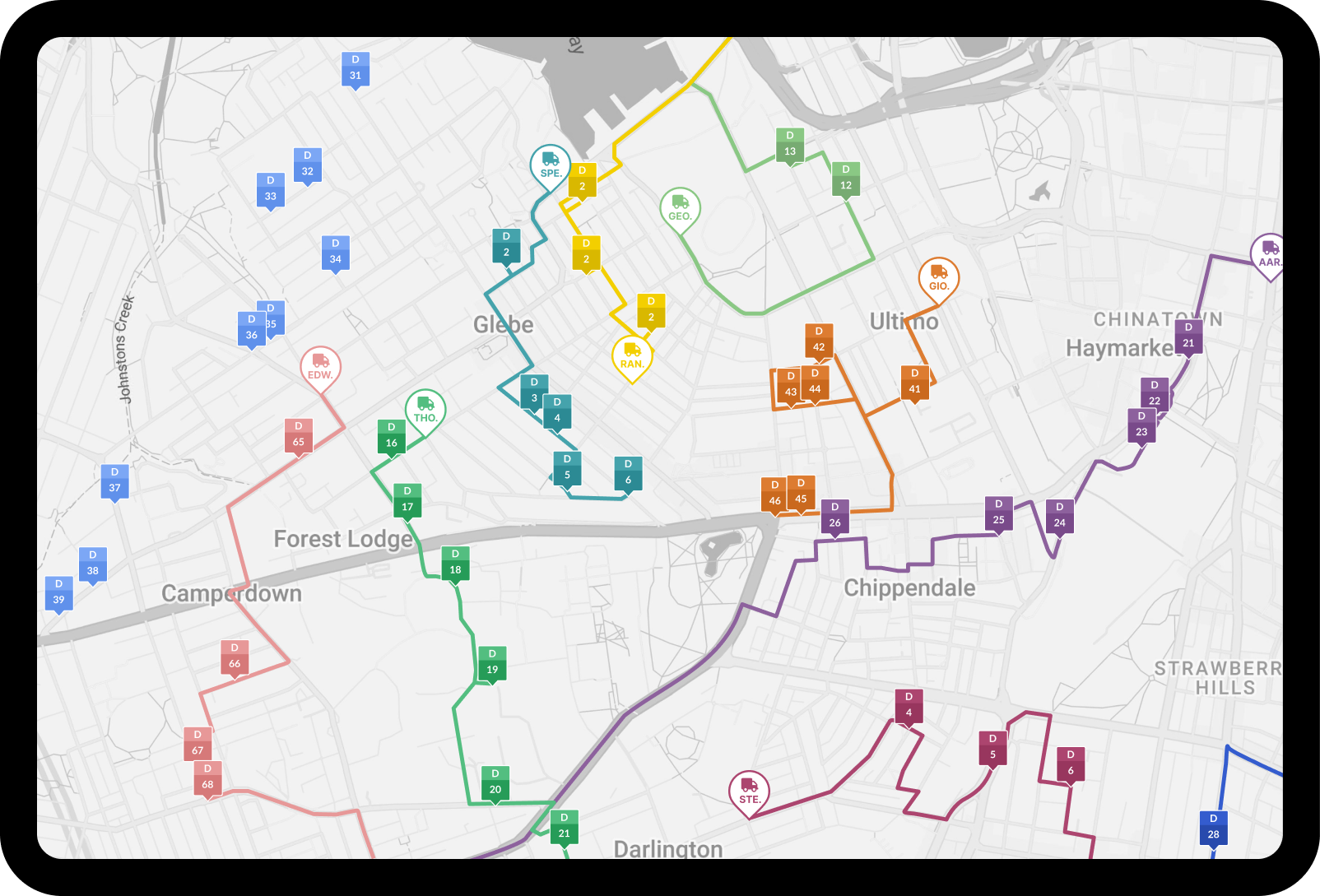
Rather than sequencing runs based on the next closest location; they account for variables like tolls, side of the street, and even tunnels that larger vehicles couldn’t fit through. That means fleets hit more delivery windows, reducing kilometres on the road and fuel consumption. And dispatchers can track every vehicle in real-time.
Site access reality
Sites have induction requirements, locked gates, delivery windows, and no letterbox. Meanwhile new builds sit on lot addresses that mapping providers have no record of. NowGo reaches lots that standard maps don't know exist yet, so a driver isn't circling an unnamed street looking for a slab.
Live re-planning
When a vehicle breaks down at 7am, the system reallocates the affected jobs, resequences the runs around them and updates the ETA the customer sees.
Quick assign
When an urgent order from a priority customer lands, it gets slotted into a live run and consolidated with anything already heading to that address. That means avoiding a second run and avoiding making the customer wait until tomorrow.
Proof of delivery
Photo, map coordinates, sign-on-glass signatures, or notes are captured in the driver app and attached to the job. Customer service has immediate access to PODs the moment a job is completed, instead of waiting for end-of-day paperwork or chasing drivers mid-route.
An app your drivers want to use
From fast barcode scanning to offline mode and delivery confirmation, NowGo’s driver app is built to simplify their day-to-day and improve job satisfaction.
How NowGo supports Reece’s 2-hour delivery at 650 branches
For Reece, Australia's largest plumbing and bathroom supplier, delivery is core to the business. Historically branches manually allocated deliveries based on a dispatcher’s local knowledge. While effective on a smaller scale, the model struggled as the business grew, and it lacked the data required to make decisions, and failed to meet the evolving needs of customers and the business.
Reece turned to NowGo to build its ‘network of the future’, and specifically:
- Replace legacy systems with a scalable, AI-powered platform
- Maintain a two-hour delivery promise across 650+ branches
- Support the rollout across varied roles and digital skill levels
- Balance central optimisation with local branch control
Through NowGo, Reece upheld its two-hour delivery promise to customers across 650 branches - increasing DIFOT in the process - equipped branches with real-time, fleet-wide tracking, and integrated with customer-facing systems, including its trade app maX.
Across other fleets running on NowGo, operators are seeing a 12% improvement in fleet efficiency, a 15% lift in utilisation, and have collectively saved millions of KMs of vans on the road, reducing fuel consumption.
Don’t let spring or a scaling operation break your fleet
To see how leading fleet management software handles complexity and improves performance at scale, book a demo of NowGo.