Stay in the loop
Subscribe to receive the latest email news and updates from Shippit
Australia’s truck driver shortage is worsening, rising from 10% to 12% in 2025, according to a recent report from the International Road Transport Union (IRU). What’s more, 24% of the existing workforce, equating to 43,000 drivers, are expected to retire by 2030. Driver shortages are being compounded by Australia’s growing freight task, with government forecasts suggesting that road freight volumes in Australia are set to grow 77% by 2050.
Route optimisation software like NowGo by Shippit exists to help fleets improve throughput, lower cost-per-delivery, and increase DIFOT (delivered in full on time) in a supply chain with fewer drivers and more freight.
Labour shortage is a P&L issue, not just a roster one
Labour scarcity has graduated well beyond the domain of a hiring manager. It is now a line item at the bottom of a P&L statement, and it’s getting worse.
Almost three quarters (71%) of carriers report peak-period delays or higher costs to hold service levels because of labour shortages, according to Shippit's 2026 State of Shipping Report. Whether it’s the retail rush or a surge in demand for construction materials, 86% of fleet operators have extended hours and 57% brought on temporary workers to get through peak periods.
Both approaches work as a short-term stop gap, but not as the medium-to-long-term solution. Delays can sabotage contracts. Higher costs erode margins. Extended hours carry overtime costs, and could trigger fatigue laws. And temporary workers often lack critical intel, whether it’s operational, geographic, or customer-specific.
The most effective, sustainable solution to labour shortages isn’t overtime or accepting eroded margins or diminishing DIFOT; it's focusing on optimising your fleet and your routes.
Route optimisation software explained
Spreadsheets and legacy systems, the incumbent method for many fleets still, are built for static routes and perfect conditions, but struggle the moment something changes.
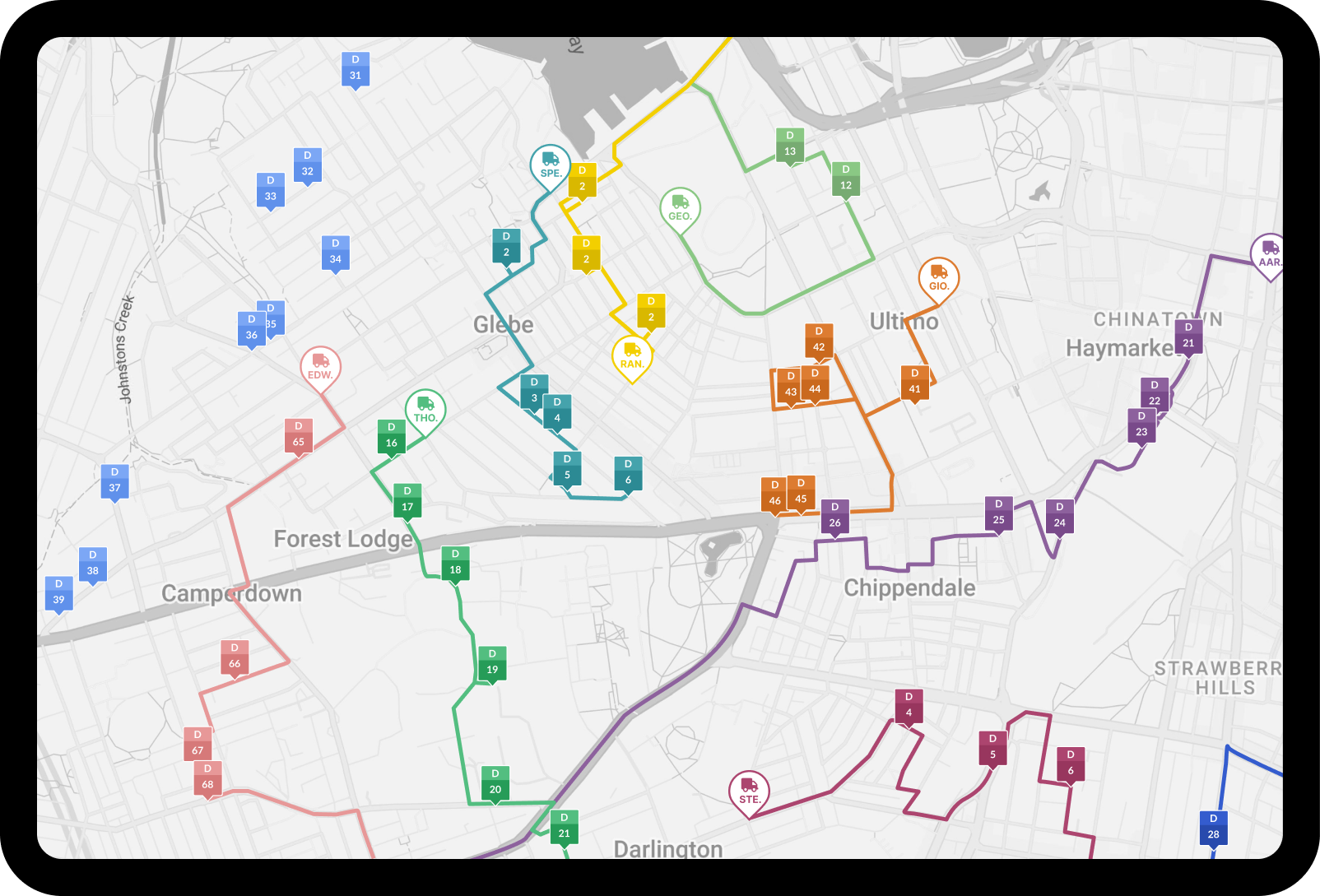
Standard mapping tools find a path between two points, whereas route optimisation software decides which driver goes where, in what order, and why.
Route optimisation software builds routes based on real constraints in your fleet: from vehicle capacity and driver hours, to delivery windows and depot cut-offs. It sequences every stop across your entire fleet at the same time, then re-plans when the day changes.
Throughput, cost-per-delivery, and DIFOT
When fleets use route optimisation software, rather than spreadsheets with a dozen tabs or a legacy system that is one bad day away from packing in, throughput, cost-per-delivery, and DIFOT improve. It’s these numbers that struggle the most when labour is tight.
- Throughput: A hand-built route that relies on habit and guesswork doesn’t optimise for throughput and struggles the second something changes on the day. Route optimisation automates those calculations based on your data and your operation, increasing throughput without adding shifts or temporary drivers.
- Cost-per-delivery: For many fleets, the more deliveries you complete in a window, the lower the cost-per-delivery. What’s more, fewer kilometres per drop cuts fuel, overtime, and vehicle wear and tear; alleviating the pressure of labour shortages and fuel volatility too.
- DIFOT: Whether it’s a formal SLA or the informal excuse they need to engage your competitor, DIFOT is the metric your customers grade you on. Anyone can promise two-hour delivery. Delivering on that promise requires visibility into your fleet, freight, and capacity before you make the promise - not after you’ve fallen short of it.
“One of the big things that we've started seeing is concerns about driver availability; finding enough drivers to drive all your trucks,” says Helen Studley, Senior Product Manager at NowGo by Shippit.
“In the early days of COVID, everyone was like, ‘I can't get enough trucks because everyone's doing online shopping’. Now we've tipped the other way and it’s ‘I’ve got all these expensive trucks, they're sitting in the yard because I can't find a driver to drive them.
“When we speak to fleet managers, there is always genuine capacity sitting in their fleets and their routes. We help them improve both.”
The knowledge that leaves with a retiring driver
While 12% driver shortages is the headline figure, the 43,000 drivers set to retire by 2030 could be even more damaging for operators that don’t focus on optimisation.
An experienced driver knows which dock at the back of the shopping centre takes a 12-pallet rigid, which construction sites have a traffic controller to streamline access, and where every gate code is saved.
When that driver retires, so too does the knowledge. The route gets slower, and your throughput, DIFOT, and cost-per-delivery suffers. Dispatchers are forced to turn to overtime or engage a shrinking talent pool, juggling every day-to-day curveball at the same time.
Route optimisation software extracts that knowledge from the silos in your dispatchers’ and drivers’ heads, and optimises your entire fleet with it. Access notes, vehicle restrictions, and delivery windows are considered and optimised for in seconds. And every extra day, route, and drop feeds the system, so performance sharpens the longer you use it.
“The most experienced drivers in your fleet know things the business has never written down. When they retire, it goes with them. When it lives in the system, the driver who starts on Monday can handle the route like the veteran they replaced,” Helen adds.
Onboarding gets shorter, too. A new driver following a sequenced run with turn-by-turn navigation, site notes and proof of delivery prompts on the app needs less shadowing before they are a crucial cog in your fleet.
What to look for in route optimisation software
Most route optimisation software struggles to fulfil the potential it claimed on its website or pitch deck. Here are six considerations when evaluating route optimisation software:
- Constraint modelling: Can it model real constraints in your fleet? Does it treat a ute and a crane as two unique vehicle types? Can it model complex load types - pipes, wire, soil, dangerous goods, create or cage spacing - or just volume and weight?
- Optimising the day: Does it allocate work dynamically, or inherit the zones your dispatchers drew a decade ago? Can it weave an ad hoc job into runs already underway? Optimisation isn’t one-size-fits-all, so can you set your own controls, whether that’s speed, cost, or service level? Does it plan for backhaul, or does the truck come back empty?
- Configurability: Does it work around your operation, or does it force you to reshape your operation to fit into its rigid system? When the operation changes, is that a settings change or six months of custom, paid development?
- Location intelligence: Can it geocode lot-style addresses at new sites that standard mapping doesn’t have? Can drivers build on that over time, with entrances, docks, and parking spots? Can it apply road restrictions to the vehicles they affect, without blanket-applying them to your entire fleet?
- The driver app: Do your drivers want to use it? Does it capture just proof of delivery, or does it capture every detail and check unique to your business, freight, and customers? Does the customer get an ETA without the driver stopping to send it?
Where to start
Almost half (43%) of fleets expect the operating environment to get harder over the next 12 months, according to Shippit research. The driver pool is shrinking, margins are contracting, and customer contracts are getting harder to earn and easier to lose.
The fleets that come out in front are the ones that get more out of every shift they roster. That means route optimisation. NowGo plans, sequences, and re-plans routes for some of Australia’s most complex fleets, including Reece, Mitre 10, and Healius.
“NowGo builds its own optimisation algorithm rather than licensing one,” Helen adds.
“Other platforms in the market tend to sit on third party engines for their map data and their routing. We do it ourselves, which means we have real control over how we handle constraints, so customers can model the way their operation already runs into the system instead of bending the operation to fit the software."
If you want to see how NowGo can improve your fleet’s performance and efficiency, and reduce the pressure of labour shortages, book a demo: https://www.shippit.com/products/route-optimisation-software